.jpg/:/rs=h:200,cg:true,m/qt=q:95)
.jpg/:/rs=h:104,cg:true,m/qt=q:95)
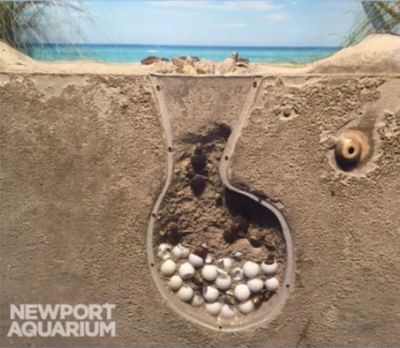
model of egg clutch
This cross-section model of a nest under the sand shows a clutch of eggs that is larger than the actual size of a Loggerhead or Green turtle and more closely represents the size of eggs of a much larger Leatherback turtle.
When a female turtles’ clutch of eggs is ready, she will emerge from the sea to carefully selected her nest site. Reptiles cannot lay their eggs in water. She must crawl up the beach to the base of a dune or higher sloped beach to keep her eggs safe from tidal washes. Nests that wash over during storms but do not completely wash away or become submerged for a time often hatch.
Once she finds a site, she will prepare the site by pushing aside sand with her front flippers digging what is called a body pit. All species do this slightly differently – Kemp’s ridleys are smaller and their nests are not as deep, Loggerheads are usually neater about this and not as deep as the Green turtles, which move a lot of sand or the very largest Leatherbacks that create huge disturbed areas on the beach.
After constructing the body pit, she digs into the sand with her hind flippers to dig a hour-glass shaped nest chamber down into the sand where she lays her eggs. She then pushes sand around, covering the nest area and carefully packing it down and throwing loose sand around to camouflage her nest area before she leaves to go back to the sea.
About 2 weeks later, the same turtle may lay another nest close by. She usually lays multiple nest each season.
After laying hundreds of eggs during nesting season and then migrating up to thousands of miles, she must find food, rest and replenish energy and nutrients before returning during another season. She typically returns after 1-3 years.
The number of eggs in a clutch varies and nests laid later in the season by same turtle may be smaller:
Loggerheads – average 115 eggs per nest
Greens – average 135 eggs per nest
Kemp’s ridley – average 103 eggs per net
Leatherback – average 80 eggs per nest
Hawksbill - average 140 eggs per nest *
*(nests in Florida Keys and more tropical and subtropical beaches- not locally)
Image of clutch: Newport Aquarium