.jpg/:/rs=h:200,cg:true,m/qt=q:95)
.jpg/:/rs=h:104,cg:true,m/qt=q:95)
Hatching
Turtle display created by Carol Leonard with the ceramic hatchling models created by Sally Storsberg and Gordon Warren. They are larger than actual size.
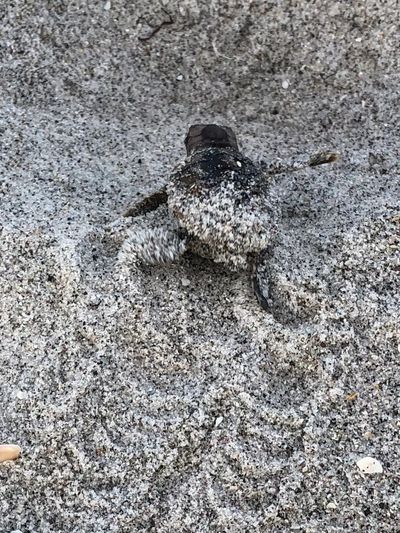
Baby sea turtles called hatchlings usually emerge together from the nest at night and crawl out to the shore in a “frenzy”. If you see this Please do not touch, surround or get between these hatchlings and the water. No noise or lights, PLEASE.
You might see turtle patrol volunteers digging into a nest. This is done AFTER a hatch to allow us to collect data as part of a Nest Productivity Assessment for the Florida Marine Research Institute of the Florida Wildlife Conservation Commission.
Not all eggs hatch. During excavation volunteers carefully remove all the contents of the nest cavity, count and record data and then rebury them in the nest chamber. These unhatched eggs and shells of hatched eggs are important sources of nitrogen and phosphorus that fertilizes the plants that struggle to grow on low-nutrient dunes.
At the time of the excavation of the hatched nest, we might also collect samples for both DNA and isotopic analysis that adds to information about which turtle is related to which other turtle or where they were feeding prior to remigration back to their nesting beaches, among other research.
Hatching success varies widely. Eggs that don’t hatch may be infertile and the embryos in the fertilized eggs may die from genetic factors, pathogens (disease), or predation. Wind and waves can erode sand from the nest or cause accretion (adding sand over top of the nest). Eggs can wash away and can suffocate when gas exchange is reduced by addition of sand or drown by inundation with standing water.
Because many eggs do not hatch, sea turtles lay many eggs within each clutch, lay multiple nests each season and nest over many seasons. Based on many years of research, population models using many factors allow scientists to estimate that a female loggerhead must lay at least 1150 eggs over her lifetime so that one of her hatchlings can replace herself. This allows her species population to remain stable. (Source: Witherington, Blair and Dawn. Our Sea Turtles.2024)
Survivorship increases as the turtle progresses through each life stage, as a turtle evades predators, boat strikes, entanglement in fishing gear and pollution. Loss of reproducing females in the late life stage can greatly reduce a population. With our help, they’ll come back to our beaches each summer.