.jpg/:/rs=h:200,cg:true,m/qt=q:95)
.jpg/:/rs=h:104,cg:true,m/qt=q:95)
tracks on the sand
Sea turtles leave their open ocean and nearshore feeding areas to come find a place to nest.
When they are of reproductive age and have enough stored nutrients, the female sea turtle looks for a mate and then only the females come on shore to construct a nest and lay their eggs.
Males almost never come ashore on local beaches. If you walk the beach in the morning and find marks in the sand that look like a tractor has moved up the beach, you have probably found the marks made by the mother turtle.
Did you know?
Loggerhead and Green sea turtles typically reach reproductive age around 25-30 years old!
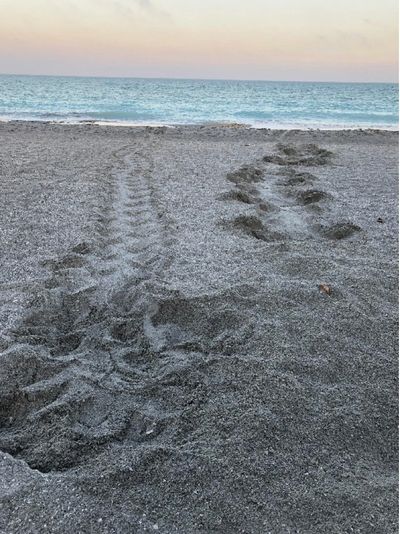
Loggerhead (Caretta caretta) nest
The shape of the tracks in the sand help us to identify which kind of turtle made these tracks.
Some of these tracks might not lead to a nest because the turtles may turn back without nesting. Turtles need dark quiet beaches that are clear of obstacles to safely select the place to nest and many things can cause them to return to the water without laying eggs. We call these tracks a false crawl when the turtle did not nest.

False crawl with a sea wall
green sea turtle track in the sand
The crawl to the right was created by a green sea turtle (Chelonia mydas).
Adult green sea turtles are the largest hard shelled sea turtle. Their crawl width is about 3 feet. The green crawls with a simultaneous movement of all of her flippers. It looks like a tractor was on the beach.
The nests of green turtles are very large. She moves about a literal ton of sand before she is finished. (Our Sea Turtles, second edition, Witherington).

Green sea turtle (Chelonia mydas) crawl. You can see the synchronous gait (straight across).